Quinnipiac University's relationship with Indigeneity: what does it mean to the ISU?
By Kalleen Rose Ozanic
Quinnipiac University is “nestled at the foot of the picturesque Sleeping Giant State Park,” according to the university’s website.
It bears the name of the Quinnipiac people, an original Indigenous group of Connecticut, and is located on their land. The university uses the park, also located on Indigenous land, as a selling point for incoming students and a venue for activities.
In recent years, the university hosted hiking events and a yoga session. In August, the school donated $7,500 for planting new trees in the park. Quinnipiac University claims to be “at the heart of the nation's best fall foliage” and cites Sleeping Giant State Park as the primary attraction.
The university’s yearly spring semester event, “Wake the Giant,” bears its name in reference to the Legend of Hobbamock. This legend, a central creationist myth originating with the Quinnipiac Indigenous people, was formerly used in official university first-year student orientations as the Legend of the Bobcat.
Enrolled member of Higuayagua and Vice President of the Indigenous Student Union at Quinnipiac University, Amada Arroyo, remembers hearing the legend at her orientation.
Arroyo belongs to the Higuayagua tribe.
“When I came here, they still had the Legend of the Bobcat,” Arroyo said. “Which, as you know, the Legend of the Bobcat said that Hobbamock was an angry Indian spirit and was, you know, soothed by the bobcat who watches over and protects him, which I think is just a very prominent example of cultural appropriation.”
Treasurer of the Indigenous Student Union, Emily Diaz, also said that the university's Legend of the Bobcat wrongfully appropriated the history of the Quinnipiac people and misrepresented their culture.

“And so I think that because the institution does not put in place proper advocacy initiatives for Indigenous peoples and representation, we don't see that very often within the story and within a lot of the conversations that have wiped Indigenous history from this land,” Diaz said.
Diaz said that appropriation plays a role in cultural erasure.
While the university no longer appropriates the legend, it remains in the memory of some students.
Arroyo and Diaz both said an official land acknowledgment is crucial to honoring the Quinnipiac people.
“I want a big plaque at the front of the school that says, 'This land belongs to the Quinnipiac people,'” Arroyo said.
"I think that there's a lack of attention and action that Quinnipiac University has made towards acknowledging the Indigenous peoples whose land we sit on," Diaz said.
Quinnipiac University’s 10-Point Plan, launched in 2020, “is intended to be a long-term roadmap to advancing racial justice for all communities.”
The eighth step, titled “Indigenous Recognition,” discusses a need for a land acknowledgment, though it has not yet been issued yet.

An overview of Quinnipiac University’s 10-Point Plan can be found in the spring 2022 Equity and Inclusion Report.

An example of a land acknowledgment, from Northwestern University.
A land acknowledgment is a “traditional custom that dates back centuries in many Native nations and communities” and an official way to recognize “the original stewards of the lands on which we now live,” according to the Smithsonian National Museum of the American Indian.
Another goal in the plan is to “enhance the pipeline and retention of underrepresented faculty, staff and students.”
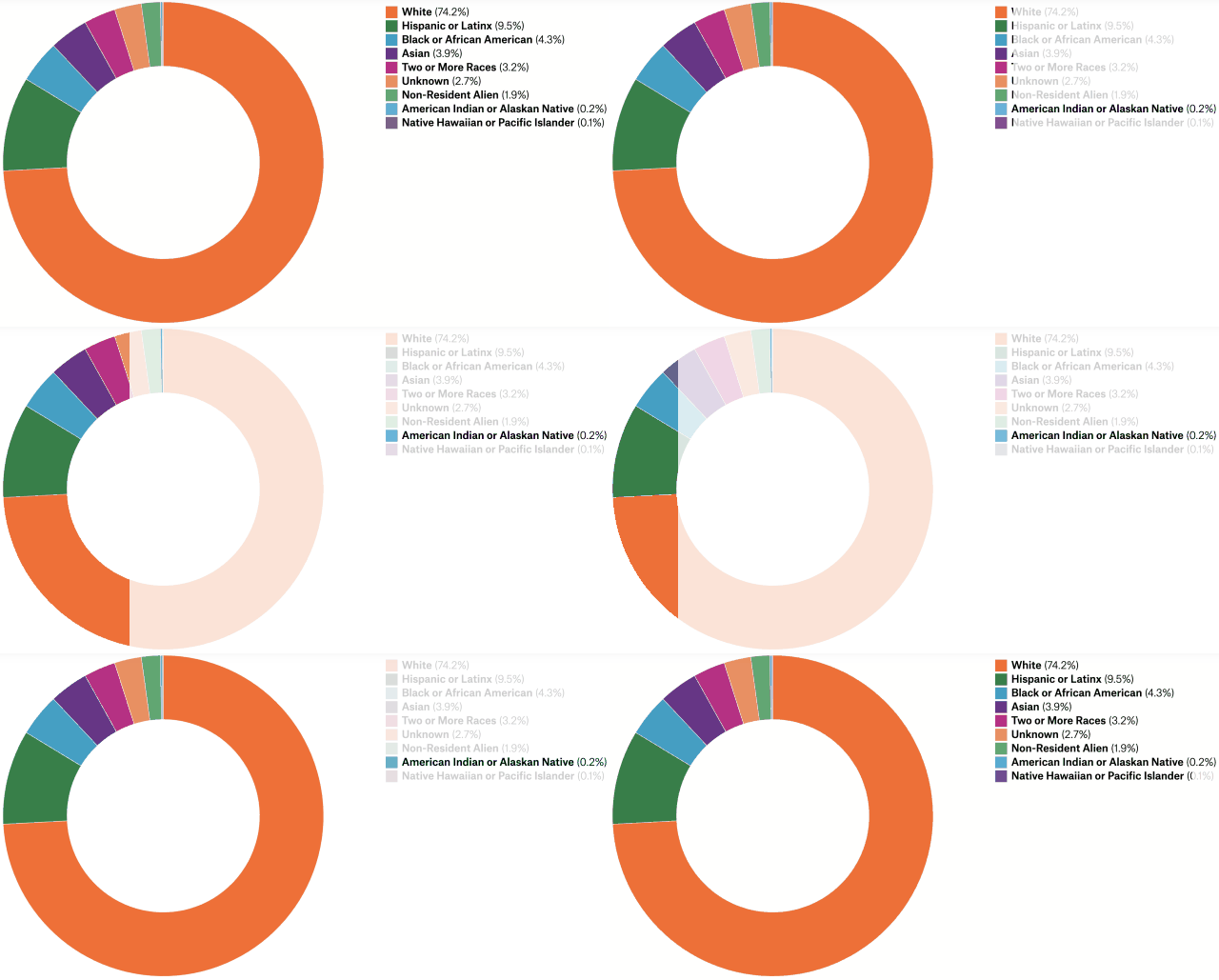
The university’s data on diversity can be found at Diversity by the Numbers on its website.
Quinnipiac University is a predominantly white institution, which is defined as any higher learning institution where white people make up 50% or more of the enrolled student body.
Quinnipiac University’s data shows that 74.2% of the class of 2025 is white.
Only 0.2% of the class is identified as “American Indian or Alaskan Native.”
Arroyo said that the diversity of the population at the university disappoints her.